The summer course offers young academics the opportunity to devote themselves intensively to a topic in the humanities or cultural studies together with a renowned research personality.
The Klassik Stiftung Weimar has been organizing international summer courses together with the Friedrich Schiller University Jena since 2010 in order to give young academics the opportunity to work intensively on a central humanities topic together with a renowned research personality. The combination of Weimar's cultural heritage and collections with contemporary questions and theories creates a unique place for exchange. Since 2026, the summer courses have been held in cooperation with the Jena Center for Romanticism Research.
Does reason have limits? On philosophical conceptual change in Germany around 1800
Not only Kant, but also many of his contemporaries were convinced that he had accomplished a philosophical revolution with his Critique of Pure Reason, behind which it would never be possible to go back. This was primarily the insight that there could be no metaphysics in the traditional sense, or more precisely: that although a priori knowledge was possible in philosophy, it must necessarily remain limited to possible sensory experience and discursive thinking. Knowledge beyond this is not possible for us humans.
Despite this, completely new philosophical concepts emerged within a very short space of time and during Kant's lifetime, which transcended the limits of his knowledge and expanded his fundamental concepts, claiming to go beyond Kant. How is this to be understood in detail? In the Klassik Stiftung Weimar 2026 summer course, we will focus primarily on isolating and analyzing the arguments that led to these revisions. In doing so, we will also compare them with Kant's own revisions in his late work, the so-called Opus postumum. One of the guiding questions in this course will be whether Kant's fundamental concepts themselves already have an inherent dynamic that pushes beyond them.
Possible topics and questions are:
- Sensuality and discursivity in Kant: why is intuition necessarily sensual for Kant, while the understanding is exclusively a discursive form of cognition?
- The 'I' as an instance of cognition: Is the 'I' an idea, as in Kant, or must it - with Fichte - be understood as an intellectual view?
- 'Life' and discursivity: Life as a boundary problem of the discursive mind or: on the epistemological function of the 'as-if'.
- Concept and movement: Are there 'living' or 'self-moving' concepts (Kant, Fichte, Hegel)?
- Limits of cognition: determination of transcendental limits of cognition (Kant) versus "Kautelen des Beobachters" (Goethe) - which position is philosophically more plausible?
- Intuitive understanding and contemplative judgment: What is meant by an intuitive understanding and to what extent is it conceivable as a possibility of knowledge?
Leader of the 2026 summer course: Eckart Förster
Eckart Förster was Full Professor of Philosophy at Ludwig-Maximilians-Universität München from 1996 to 2003 and then taught as Professor of Philosophy, German, and the Humanities at Johns Hopkins University in Baltimore until his retirement in 2021. He had previously taught at Oxford, Harvard and Stanford, supplemented by numerous visiting professorships in North and South America. He completed his studies in Frankfurt and Oxford, where he received his doctorate under P. F. Strawson with a thesis on transcendental arguments. He is also an honorary professor of philosophy at the Humboldt University in Berlin. Eckart Förster was awarded the prestigious Kuno Fischer Prize of the University of Heidelberg for his book Die 25 Jahre der Philosophie.
A selection of recent writings:
- Limits of Knowledge? Studies on Kant and German Idealism. Stuttgart-Bad Cannstatt 2022.
- Opus postumum. In: Small Kant encyclopedia. Edited by Larissa Berger and Elke Elisabeth Schmidt. Paderborn 2018. pp. 95-100.
- The 25 years of philosophy. Frankfurt am Main 2018.
- The Paradox of Hegel's Jena Logic. In: Journal for Philosophical Research 72,2 (2018). S. 145-161.
Application modalities and basic information (deadline: March 15, 2026)
The summer course is aimed in particular at doctoral and post-doctoral students in cultural studies and the humanities. If you are interested, please send a CV in tabular form and a short letter of motivation (approx. 1 page) by March 15, 2026 to: florian.auerochs@klassik-stiftung.de
The venue is the Wielandgut Oßmannstedt, about ten kilometers from Weimar. In addition to working together on texts, which we provide to participants in advance and which we actively explore in joint discussions, the summer course also includes guided tours of the Klassik Stiftung Weimar's facilities and a public evening lecture at the Goethe and Schiller Archive in Weimar.
A fee of 80 euros is charged for participation in the summer course, including accommodation and meals in Oßmannstedt as well as the cultural program in Weimar and the surrounding area.
The exchange in presence and the inclusion of local cultural offerings are essential components of the summer course for us.
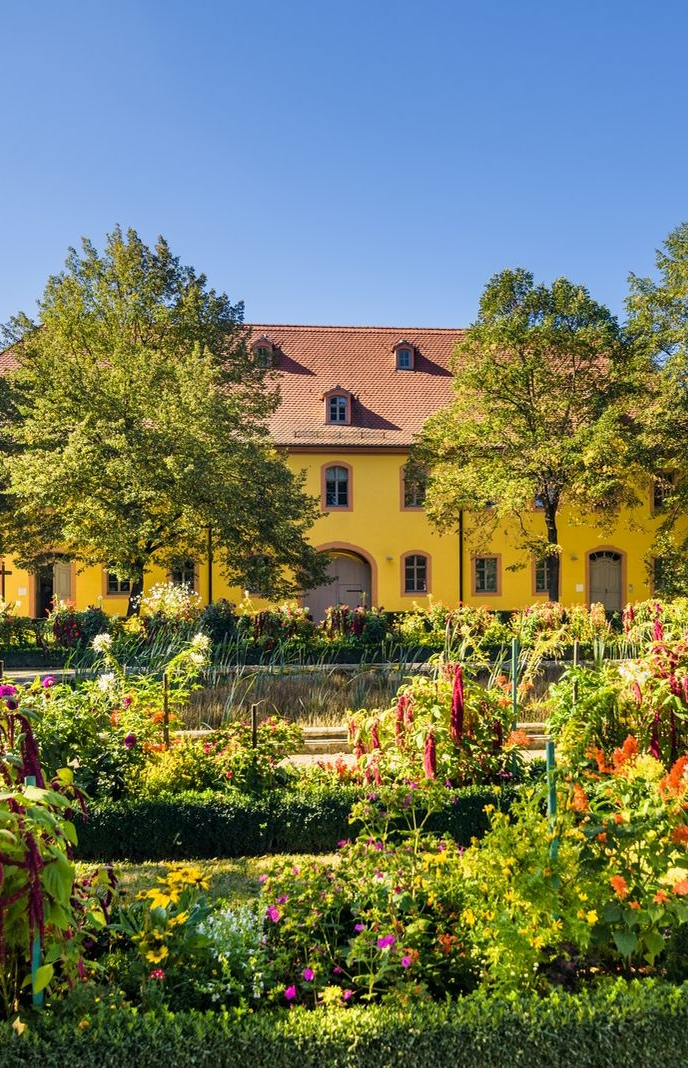
Location of the summer course: Wielandgut Oßmannstedt
Foto © Klassik Stiftung Weimar
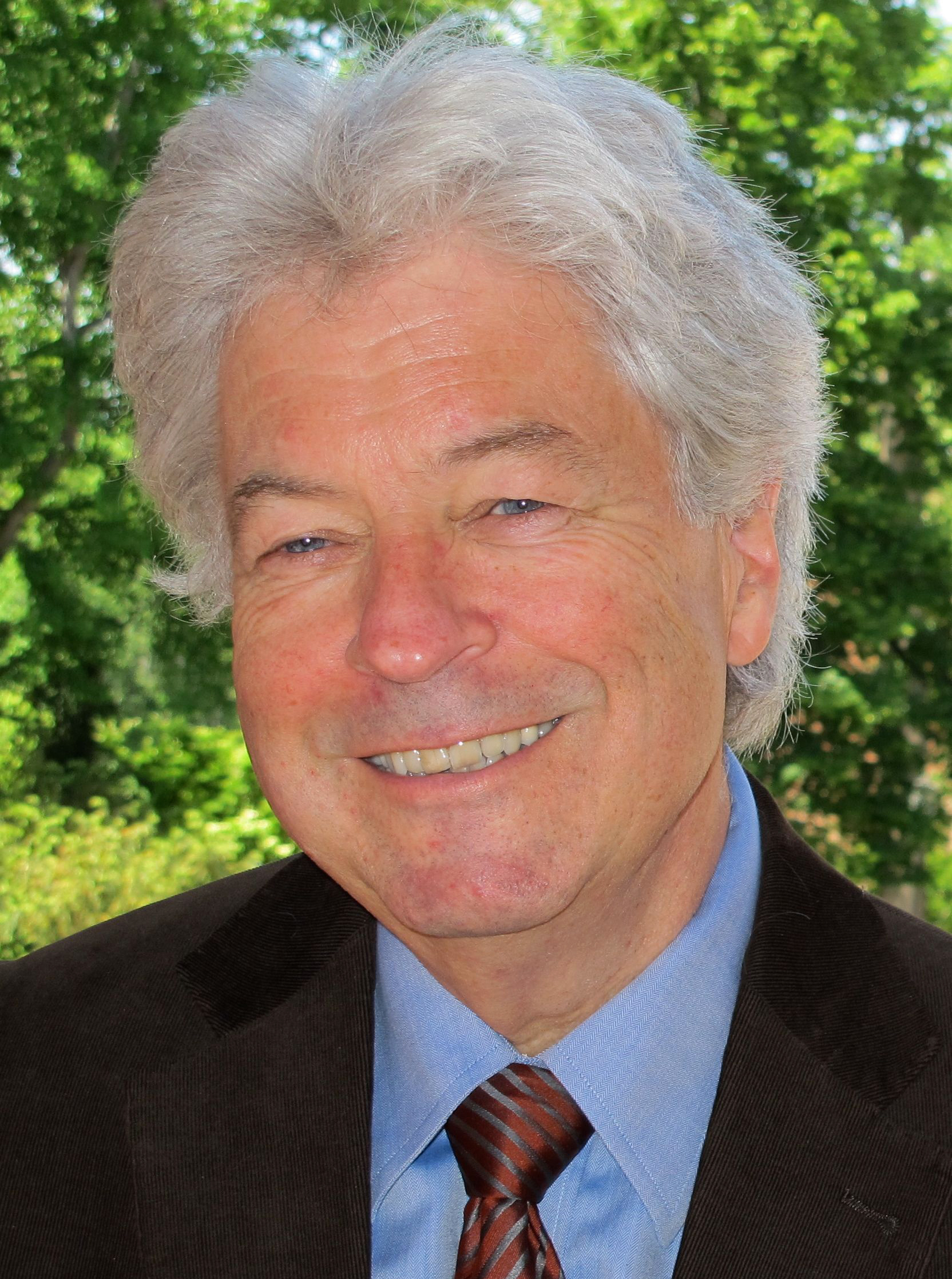
Leader of the summer course 2026: Eckart Förster